
For most passive fire protection (PFP) subcontractors, the hardest part of the job often isn't the work itself. It's proving it happened.
A fire stopping team might run a dozen jobs in a week, and evidence can end up scattered across text threads, paper sign-off sheets and undated photos.
When an inspection or a query comes in months later, someone has to piece it back together from memory. That reconstruction work is where compliance risk lives, and it's expensive.
The Get It Right Initiative (GIRI), an industry-funded study backed by CITB and a group of contractors and clients, found avoidable errors account for around 5% of UK construction project value, rising to an average of 21% once indirect costs, latent defects and unrecorded process waste are added in, according to GIRI chief executive Tom Barton.
When it comes to regulation, nowhere is this sharper than in the golden thread requirement under the Building Safety Act 2022. PFP job information has to be kept digitally, transferable, accurate and up to date, accessible to other dutyholders on request and secure from unauthorised access.
The client creates it and hands it to the principal accountable person, who maintains it, with handover confirmed at Gateway 3, the completion certificate stage.
Manual record-keeping can't meet that standard. The golden thread has to be a single, structured, auditable source of truth, not a collection of disconnected records assembled after the fact.
How fire protection software is closing that gap
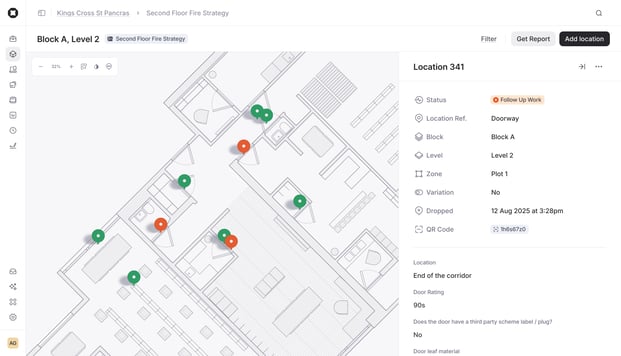
A growing number of PFP subcontractors are closing that gap by capturing compliance evidence digitally at the point of work, rather than reconstructing it afterwards.
Onetrace is one of the platforms built for this. It's software for subcontractors–used across PFP and other compliance-heavy trades, that lets site teams capture photos, forms, sign-offs and drawing markups as the work happens, rather than writing it up later from memory.
That evidence is then structured into records that contracts managers and QA leads can export and hand over for audits, client sign-off or golden thread requirements. Three examples, each solving a different piece of the problem, show what that looks like in practice.
City Fire Proofing runs up to dozens live passive fire projects at any one time across multiple sites, which makes staying in control of evidence and handover documentation a genuine operational challenge rather than an afterthought.
"We can have up to 40 projects running on any one day," says document controller and QA manager Chrissy Briant. "Without Onetrace, record keeping would easily become chaotic and inconsistent."
Reviewing completed work remotely, rather than sending someone back to site to check it, cut the cost of a fire door check from £10 to £4. Handover documentation on major projects, an essential part of the main contractor's golden thread, now comes together in days rather than weeks.
"On a large scale project, I can produce the handover documentation in days rather than weeks," Briant adds.
Golden Thread Fire Delay, a UK PFP specialist with more than 30 years' experience working with clients including the NHS, universities, local authorities and housing associations, faced a different problem on a 2,500-fire-door installation, remediation and inspection programme at Greenwich University.
Previously, operatives had been filling in manually completed, non-standardised worksheets, so installation information often had to be double-checked and sites revisited, and small inconsistencies between surveys across a multi-building site made it hard to maintain one golden thread of information.
Customised digital forms, drawing-based location marking and asset tag numbers made the Greenwich records accurate and consistent, and client guest access gave visibility that supports ongoing fire door inspections.
Contracts manager Kris Konieczka says: "I am confident that we have saved hundreds of hours of administrative work on our largest project."
TBL Fire Protection's issue was time, not accuracy. Before adopting digital records, the team relied on Excel, marked-up hard-copy drawings and printing large volumes of documents, and spent significant time on admin without a consistent overview of live projects.
Now, operatives mark up shared PDF fire strategy drawings with location pins, so everyone works from the same document, and the team gets a real-time view of project status instead of manually reconciling data.
As operations, quality and systems manager Martin Logie puts it: "The biggest difference Onetrace has made is having more time in the day, as myself and the team now are not having to manipulate data to find out what is going on or chase up how and where things are progressing on site as it's visible instantly from the system in a bird's eye view."
From compliance to competitive edge
Gateway 3's requirement to confirm handover puts a hard checkpoint on this, and principal accountable persons who inherit the golden thread need evidence they can rely on, not evidence they have to chase. Insurers and main contractors are asking the same questions earlier, and subcontractors who can hand over structured, dated, verifiable evidence are simply easier to work with.
For City Fire Proofing, Golden Thread Fire Delay and TBL Fire Protection and the other 1,000+ subcontracting businesses using Onetrace, that evidence does double duty. It satisfies the golden thread and the audits that follow, and it's what wins the next conversation with a Tier 1 contractor, an insurer or a client who wants proof of quality before they commit.
As digital traceability becomes the baseline rather than the differentiator, these subcontractors aren't just meeting the obligation. They're using it to compete.
Find out more about digital compliance evidencing for passive fire protection subcontractors at onetrace.com.
Register your Interest for the Fire Safety Event 2027 | NEC Birmingham | 27-29 April 2027: The Fire Safety Event.
Subscribe to Fire Safety Digital for monthly updates.



.png)
